Commissioner Channels Personal Experience into Public Message
“When I was campaigning for my reelection and got diagnosed, I had to reframe my understanding of my cancer to realize that though I did not choose colon cancer, God has entrusted me with it. So now I need to do something about it. In addition to my continued advocacy for mental health funding and preventive health access, I will be a fierce proponent for colon cancer screenings. Colonoscopies Save Lives.”
Life-altering days are often marked by detailed recall. For Bexar County Commissioner Rebeca Clay-Flores, Oct. 18-19, 2024, are replete with such memories.
On this particular Friday, Clay-Flores was headed to San Antonio’s Northwest Vista College to co-host a city/county veterans resource fair where she was scheduled to speak on a panel. As an advocate for mental health resources for seniors and veterans, this event was of paramount importance.
The Commissioner glanced at her phone, saw a message from her doctor, and stepped out of her chief-of-staff’s car to return the call.
Unbeknownst to most, Clay-Flores had been wrestling with her health since January 2024, consulting doctors and undergoing various treatments while simultaneously serving the 500,000-plus residents of Precinct 1 and knocking on doors campaigning for her second term. At this point on the election timeline, the Commissioner had already faced five opponents in the 2024 primary, won her run-off, and was headed into the general election.

Standing on the sidewalk, in this brief pocket of time sandwiched between a lunch meeting and a major event, Clay-Flores received the results of her colonoscopy and a diagnosis of colon cancer.
“I broke down and I cried, and I asked all the questions,” she recalled. “Nothing could be answered until after surgery and pathology.”
Clay-Flores called two friends who prayed with her over the phone. Then she got back into the car, where her chief-of-staff and campaign manager were waiting. While both could see she was upset, she chose to keep the matter private. Clay-Flores didn’t miss a beat, completing a scheduled phone interview in the car on the way to the resource fair and then taking her place on the panel.
“I sat there and answered questions about mental health advocacy for veterans that I had pushed for and available resources,” she remembered. “But at the same time, I’m looking at the audience and thinking how no one knows that I have a bleeding cancer tumor inside of me.”
Some 24 hours later, Clay-Flores experienced another defining moment, one of acceptance and resolve. Part of her Christian walk includes keeping the Sabbath and attending two worship services on Saturday: one at her home church, and a second at a migrant center at the time. Physical, emotional, and mental exhaustion had set in, so Clay-Flores chose to stay home from the first service and attend the migrant worship later in the day because she was the organizer.
Her previous pastor’s wife had sent her a sermon on the suffering of Job, so she took in that message on the morning of Oct. 19. Job 13:15 spoke to her: “Though He slay me, yet will I trust in Him.” She reflected on the sermon, cried and prayed, and then cried and prayed again. She came to understand that God had “entrusted” Job with suffering and started using that word.
While coming to terms with her diagnosis, Clay-Flores armed – or tried to arm – herself with resources, searching online for information on colon cancer. She quickly realized there was little to be found, and the seed to spread awareness was planted.
“Within 24 hours of my diagnosis, I had to reframe my mind and my understanding in order not to freak out and cry in the middle of previously scheduled events. I accepted that I didn’t choose colon cancer, but God had entrusted me with it.”
The next 17 days leading up to the Nov. 5 General Election were filled with media interviews, speaking at political rallies, door knocking, and meetings with her surgeon and oncologist. Choosing to keep the matter completely private, the Commissioner smiled through the anxiety and fatigue and persevered.
“It was really my faith and my relationship with Christ that got me through that time,” she shared.
Clay-Flores won her election with 59 percent of the vote. Afterward, she underwent a six-hour surgery and spent five days at UHS, the University Health Bexar County Hospital System.
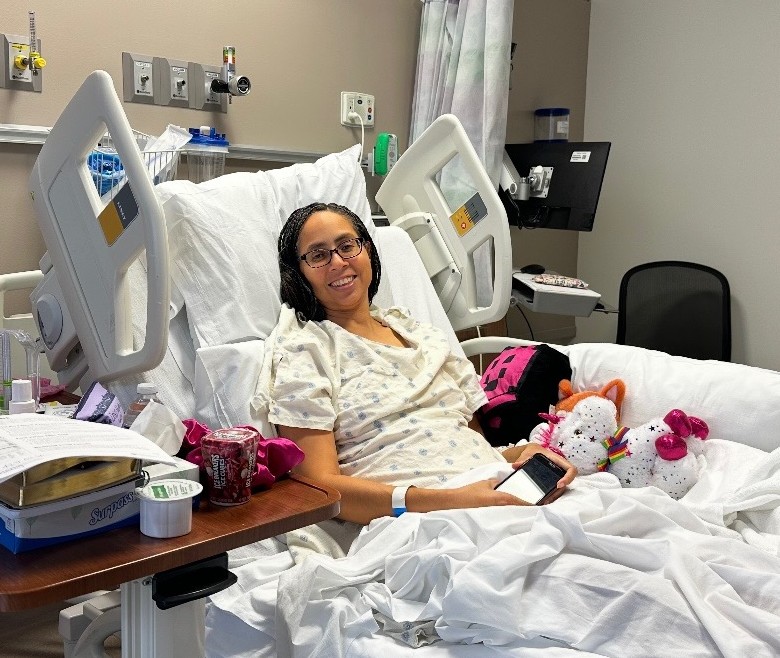
After missing two Commissioners Court meetings– when she had previously never missed even one – and with a long recovery journey ahead, it was time for Clay-Flores to make her diagnosis public. In early January 2025, she asked for a “point of personal privilege” and read a statement during Commissioners Court summarizing what she had been through and how she would proceed.

“In addition to my continued advocacy for mental health funding and preventive health access, I will be a fierce proponent for colon cancer screenings,” she read. Clay-Flores’ full address is available at https://bit.ly/clay-flores-statement.

Putting words into action, the Commissioner organized a health fair in her precinct last March and has organized even more this year around and during March, which is National Colorectal Cancer Awareness Month.

Charting a Course
Following her public statement at Commissioners Court, Clay-Flores was surprised by the response, with multiple requests for interviews and invitations to share her story. While she has generously woven her personal story into her awareness campaign, Clay-Flores has elected to keep some details private. The specifics she does share all lead to the message she is committed to spreading: Colonoscopies Save Lives.
- Healthy, energetic men and women in their 40s without a family history of colon cancer can contract colon cancer. Prior to symptoms, Clay-Flores was an avid walker and 19-year vegan with an active lifestyle. Following other diagnoses and treatments, it was a colonoscopy that yielded the correct diagnosis. Later genetic testing revealed she did not have a family history.
- The recommended age to begin colorectal cancer screening is 45, according to the Colon Cancer Coalition https://bit.ly/crc-screening. “Colorectal” is an umbrella term that includes rectal cancer and colon cancer. The screening age was lowered from 50 to 45 by the American Cancer Society in 2018. “I was not aware of the need for preventive screening at age 45,” Clay-Flores said. “I do not think most people are aware that the screening age has changed.”
- Colorectal cancer disproportionately affects the Black community, where the rates are the highest of any racial/ethnic group in the United States, https://bit.ly/higher-colon-cancer-risk, https://bit.ly/colon-cancer-risk. “I asked my gastroenterologist (GI) doctor if I had any risk factors. He said only my race; though I am Black and Mexican, he was referring to me be being Black,” Clay-Flores specified.
- Colonoscopies Save Lives. The possibility of a fatal outcome was not lost on Clay-Flores. While awaiting the scheduled surgery, she simultaneously “got my house in order” for the sake of her family, and also met with her attorney to update her will. “I know who my Savior is, so I am ready to go, but there are a couple of things I would still like to do. I was prepared to die, but fighting to live,” she said. So it bears repeating: A Colonoscopy Can Save Your Life.
The nature of the cancer – where it is located in the body and the necessary preparation and testing – may not lend itself to comfortable conversation, Clay-Flores noted. However, when advocating for screening, the Commissioner tells her audience, “Getting a colonoscopy is much more fun than having surgery for colon cancer.”
In the meantime, Clay-Flores is regaining her strength and energy.
“I am getting better week by week,” she shared. “I am still in physical therapy, and I am doing well. My prayer is that the cancer will never come back in any form.”
For more on Commissioner Clay-Flores, go to https://bit.ly/clay-flores.
For more on colon cancer, click here: American Cancer Society Colon Cancer Fact Sheet