

*** Click here for the audio version.***
A municipal utility district (MUD) is a state governmental entity that provides utility services to designated areas. A MUD may be created by the Texas Legislature or by the Texas Commission on Environmental Quality (TCEQ) following a petition and consent process described in the Texas Water Code.
MUDs are usually created to provide water and wastewater services and maintain drainage facilities. Chapter 54 of the Texas Water Code explains the specific purposes of a MUD, https://bit.ly/watercodeMUD.
These districts are often initiated by housing developers to build infrastructure to attract residents to developments. Developers are subject to the zoning and ordinance-making authorities in cities, which must consent to a MUD; counties have very limited authority and cannot prevent the creation of a MUD.

MUDs are managed by a board, which is elected by a property owner or property owners within the MUD. One vote is all it takes to create a district, establish a board of directors with borrowing authority, and obligate future residents to a tax burden. A MUD may issue bonds to reimburse a developer for authorized improvements.
MUDs may not always provide for infrastructure needs beyond utilities. Residents may be left without expected services, including emergency medical and law enforcement, and with an unexpected tax burden. Another related complication may be overcrowded classrooms.
Local Impact: Comal County
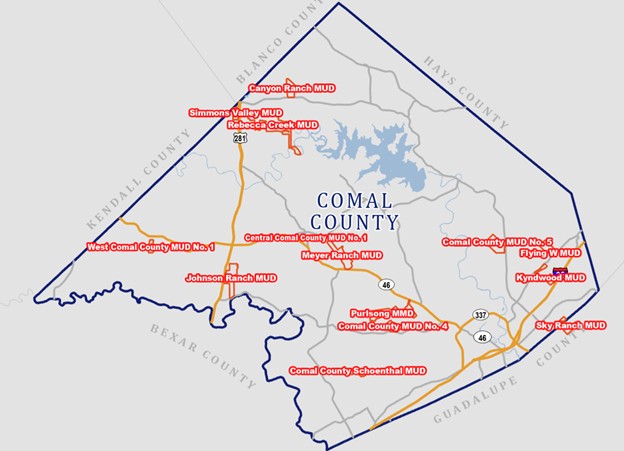
Comal County is currently home to 14 MUDS, confirmed County Commissioner Jen Crownover, who has both short-term and long-term concerns regarding local impact.
“Short term, the impact we’re seeing is clear-cutting of entire hills in our county, and sometimes even leveling these hills so developers can carelessly pack as many homes on a parcel as possible,” Crownover reported. “This displaces wildlife, changes drainage and recharge, creates a crazy amount of dust, changes noise patterns because the vegetation is scalped, and absolutely infuriates our residents.”
The major long-term concern is overdevelopment at the cost of already-scarce resources, especially water, she continued.
“Creating MUDS allows a developer to build wastewater treatment plants, which gets around our 1-acre minimum requirement for household septic systems,” Crownover underscored. “This high-density development packs in more people to a small area where the roads and schools are already at capacity, and that burden will fall on the current taxpayers (eventually).”
Another long-term effect is the MUD taxes that residents will end up paying, Crownover specified. MUDS are not subject to the same budgetary discipline and scrutiny as counties, school districts, emergency services districts (ESDs), etc., including the 3.5 percent revenue cap.
“Not all homebuyers are wise to that when they buy into those neighborhoods,” Crownover elaborated. “When those MUD rates go up, it has a huge impact on these homeowners.”
Crownover described the one-vote establishment of a MUD as “a scam and an insult to elections.” When an ineligible voter cast the one vote in a proposed local MUD in Comal County, the developer simply moved a different voter into the district and filed for another election.
MUDS are appropriate in certain circumstances where the developments are compatible with what is around them and they offer some public benefit for the infrastructure that they are able to finance, Crownover observed.
For example, the MUD pictured below, Singing Hills, brought in some major infrastructure to an otherwise underserved area that backs up to the city of Bulverde.

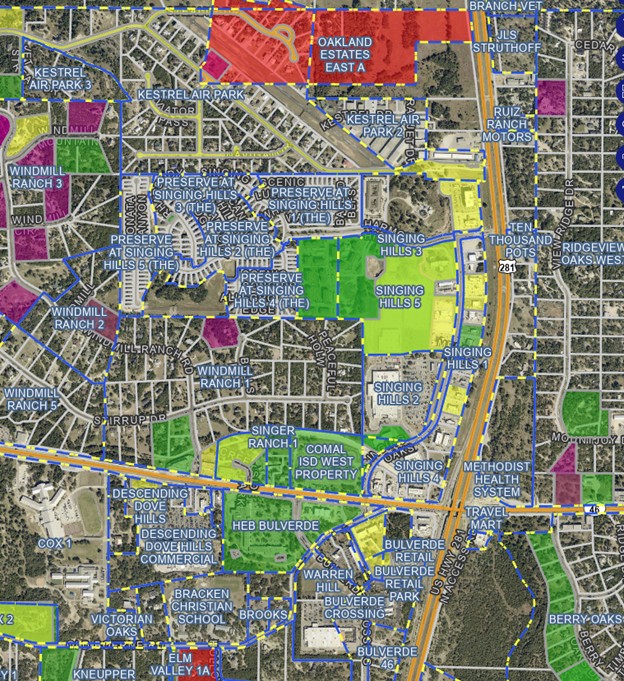
“The wastewater treatment actually opens up the door for other development in this area for things such as restaurants and medical services, which would otherwise be nearly impossible if they could not tap into those resources and had to rely on their own septic, etc.,” Crownover explained.
Other MUDs do not serve the public but rather create an eventual burden. As seen in the Canyon 400 area designated below, no nearby services or infrastructure are in place to serve the 1,600 planned homes on 400 acres.
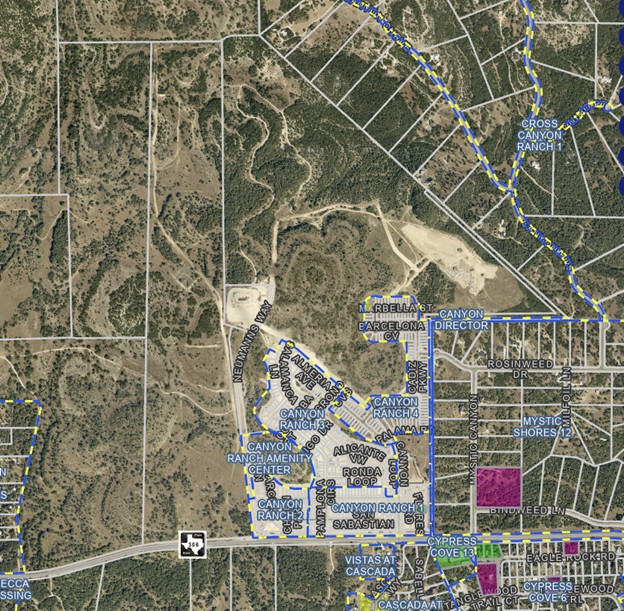
“When MUDS are allowed anywhere, as they are now, it just opens up the door for the developers to have easier financing for their projects without any public benefit,” Crownover said. “All of this is done knowing that the county has exactly ZERO authority to stop them.”
The burdens of these types of MUDS are also absorbed by the established citizens in those areas with regard to overcrowded schools, Crownover continued, in addition to increased ESD calls, increased law enforcement needs, and road infrastructure that is pushed beyond capacity. The Commissioners Court has no ability to stop the creation or influence the development into something more palatable to the landscape that already exists.
“The bottom line is that counties need a seat at the table to discuss whether a MUD is a good fit for an area,” Crownover maintained. “The county also needs to be able to have input on what that development would look like and how it could be made more compatible with what already exists in the area. In addition, the county should be able to deny approval of a MUD due to density concerns and strains on current services, resources, and what’s already existing in any given area.” Some MUDS offer some degree of public benefit, Crownover concluded, while others cause nothing but public burden. Counties need the authority to help alleviate that burden.
Members of Commissioners Court worked with the CJCAT to develop and adopt the following Resolution:
Opposition to Granting Powers to Municipal Utility Districts and Special Utility Districts
WHEREAS, city government and county government should have appropriate authority to regulate growth in their respective counties and cities; and
WHEREAS, special water districts and private water corporations have the means to furnish water and provide for growth in rural areas of the counties; and
WHEREAS, municipal utility districts and special utility districts have been improperly used by certain developers to avoid compliance with county and city infrastructure plans;
NOW, THEREFORE, BE IT RESOLVED that the County Judges and Commissioners Association of Texas opposes the granting of additional powers to municipal utility districts, special utility districts, and any special districts, and requests that the approval of the county be required before any further districts are created.