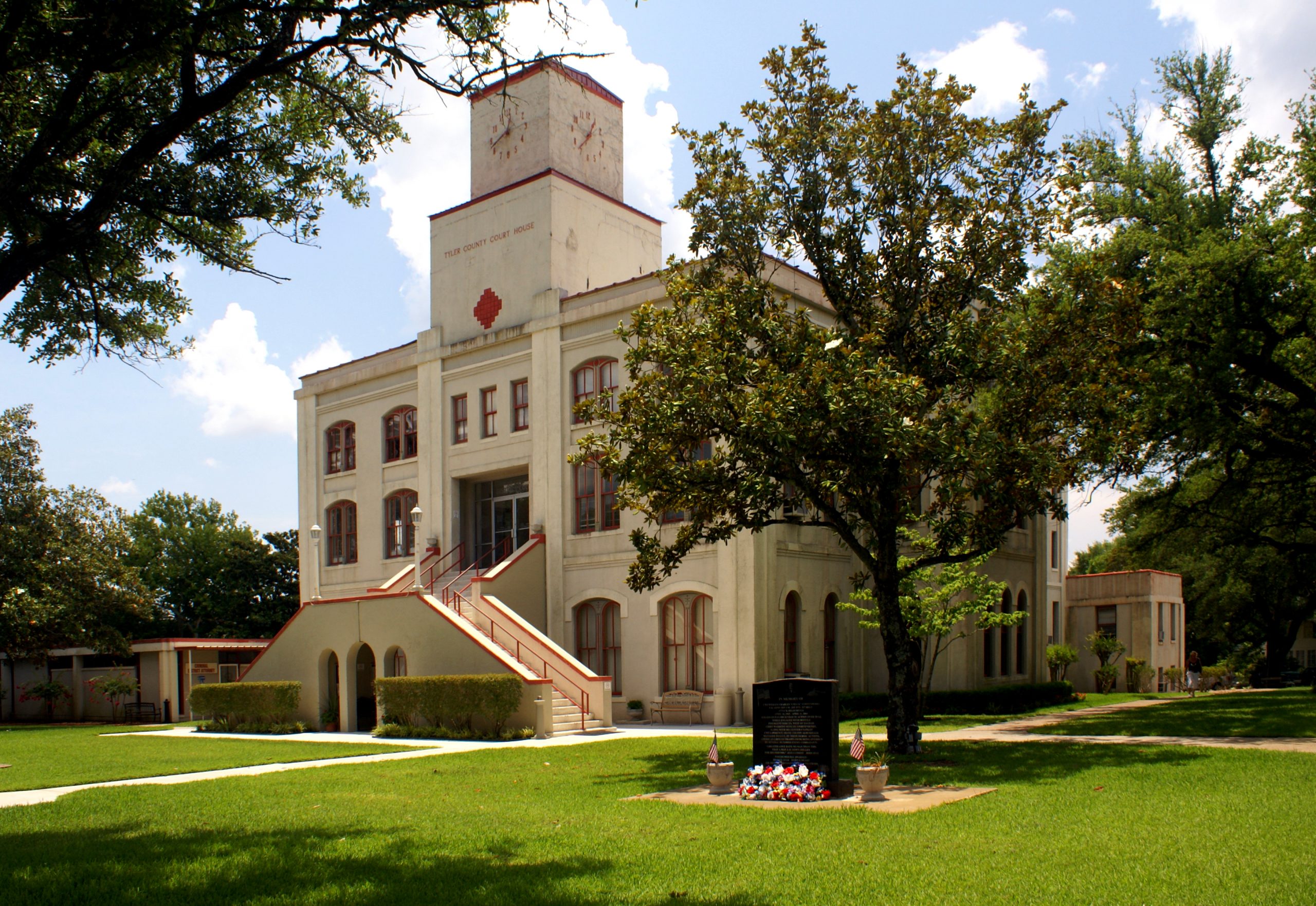
The Tyler County Courthouse was built in 1891 in an Italian Renaissance style.
In 1935, the county launched a remodeling project with Works Progress Administration funds, as explained by the Tyler County Heritage Society. Efforts to modernize the building resulted in the removal of its more “high style” elements and the construction of a rear addition. However, character-defining features from the original design, such as the windows and central, tower remained.
Tyler County was created and organized two times, first as the judicial county of Menard. The courts later declared Menard and other judicial counties unconstitutional.
In 1846, the Texas Legislature created the current Tyler County, named after President John Tyler. Dr. Josiah Wheat donated 200 acres to establish Woodville, the county seat, named in honor of Gov. George T. Wood, who helped establish the county.
According to historians, there is no actual record documenting the county’s first courthouse. However, papers refer to an order for a new jail to be built east of the courthouse in February 1849. A two-story frame courthouse built in 1856 served the county for more than three decades. T.S. Hodges designed the third and final courthouse, which was financed by a $30,000 bond issue.

In 1882, the Sabine and East Texas Railroad constructed a line from Kountze to Rockland that ran the length of Tyler County. Other lines were built to accommodate the loading and hauling of lumber. By 1890, there were 19 sawmills in operation.
As the woodlands begin to bloom, Tyler County welcomes springtime with a series of special events, as explained at https://bit.ly/dogwood-festival: “The Tyler County Dogwood Festival, the oldest outdoor historical pageant…calls attention to the beauties of the area in story, pageant, and song.” The festivities begin the weekend of March 21.
The area’s natural beauty is also showcased in the Big Thicket Natural Preserve and nearby B.A. Steinhagen Lake.
The Allan Shivers Library and Museum pays tribute to the 37th governor of Texas, who spent much of his youth in Tyler County, where his widowed great-grandmother settled in the 1850s. The Shivers’ homeplace is just west of Woodville and is still owned by the family. The museum houses an extensive collection of personal and political artifacts belonging to Allan Shivers, as well as over 50 original political cartoons from the late 1950s and early 1960s.
The Tyler County Heritage Society, a non-profit organization, owns and operates the Heritage Village, the Museum Store, the Pickett House Restaurant, the Whitmeyer Genealogy Library, the Clyde Gray House Museum, the Big Woods Nature Trail, and the Cauble House, all of which offer a glimpse into the area’s rich history.
The Heritage Village depicts pioneer life in Tyler County from the mid-1800s to the early 1900s. Described as “The Front Porch of Tyler County,” the Village features the Tolar Kitchen, a historic structure built in the 1860s and moved to the Village in the 1960s, and the Cherokee Church, moved to the Village from the Dies Community. Other reconstructed buildings, including a one-room schoolhouse, blacksmith shop, and homesteads, bring the traditions that helped shaped East Texas back to life.