“Today, we begin writing the next chapter. This restoration will give future generations a courthouse that honors where we’ve been and inspires where we’re headed…a building worthy of the community that it serves.” Refugio County Judge Gigi Poynter – Groundbreaking Ceremony, Jan. 20, 2026
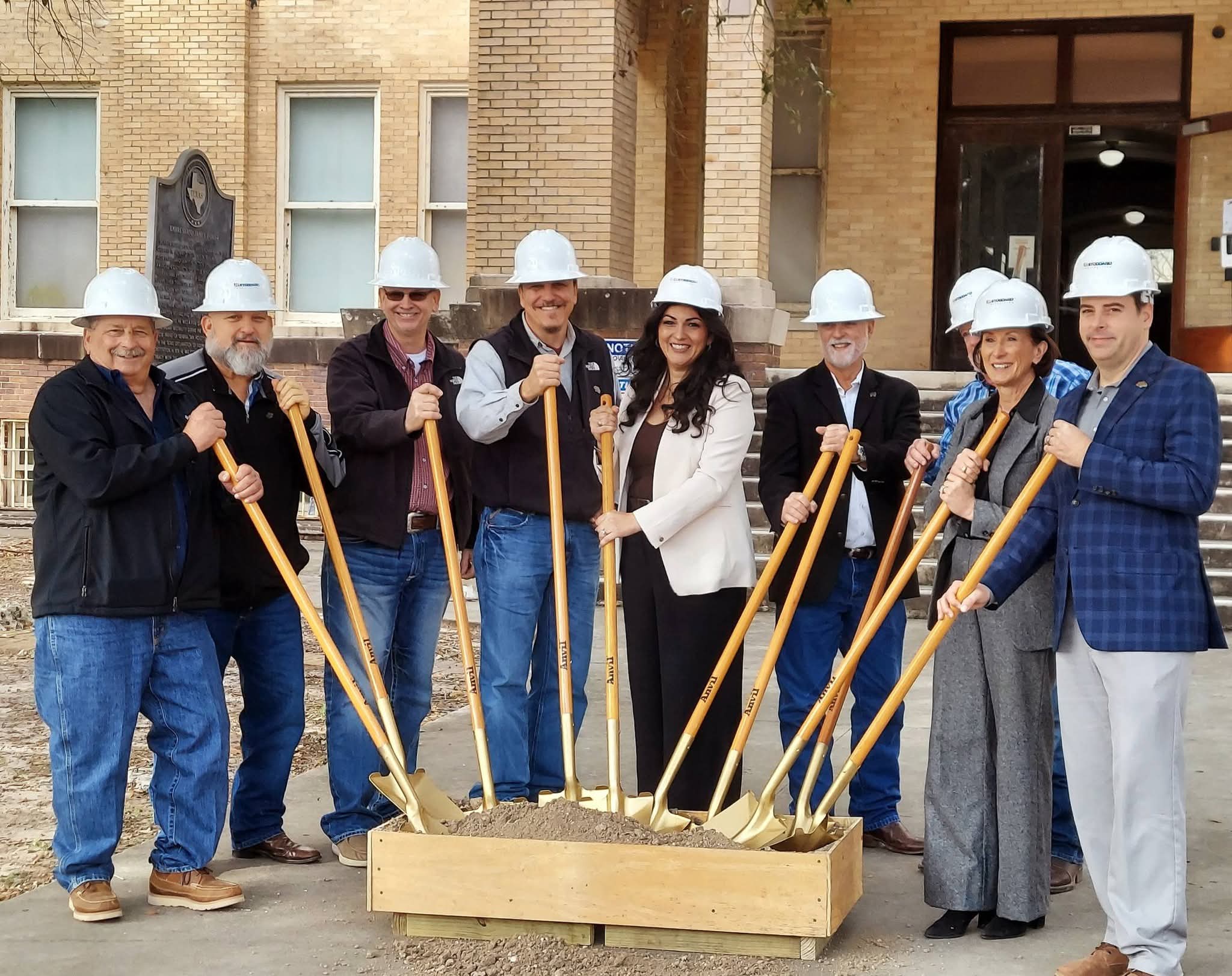
Some nine years after taking a direct hit from Hurricane Harvey, Refugio County gathered in January to break ground on a long-awaited courthouse restoration initiative beginning with critical repairs to stabilize the 108-year-old courthouse.
Refugio County Judge Gigi Poynter described the endeavor as more than a construction project.
“
This is a symbol of how we’ve shifted from reacting to crises, to building for the future. It represents a county moving from making do to making progress,” Poynter shared.

Refugio County was awarded a $4 million emergency grant from the Texas Historical Commission (THC) Texas Courthouse Preservation Program to go toward the $9.85 million cost of the first phase of the restoration. Additional funding sources include Hurricane Harvey Disaster Project funds and a loan from the Texas Division of Emergency Management (TDEM), which was recently forgiven in full, according to the Refugio County Auditor’s Office.
Poynter credited the Commissioners Court, TDEM, the THC, project partners, and the community for bringing the restoration vision to fruition.
During the groundbreaking ceremony, a brief history of the courthouse was presented by the Refugio County Historical Society and the Refugio County Historical Commission, and project overviews were provided by project partners JC Stoddard Construction and Komatsu Architecture. State Sen. Lois W. Kolkhorst also addressed the crowd.
Restoration Project Phase One
The 1917 Refugio County Courthouse was designed by Atlee B. Ayres, and its compatible 1951 additions have served the county to the present for over 100 years.
The county’s jail facilities had already been relocated prior to Hurricane Harvey, leaving the former jail space available for adaptive reuse approved by the THC in one of the phased construction stages.
The first phase of the restoration project will be stabilization and exterior restoration and rehabilitation to achieve a weather-proof condition, preserving this landmark for future generations while positioning the county to pursue additional funding opportunities for full restoration in the future.
“The courthouse will stand once again as a beacon of civic pride and a testament to what a determined rural county can accomplish when it works together,” Poynter summarized. – Komatsu Architecture contributed to this article.